
Home entertainment should be simple. When you want to watch a movie, listen to music, or turn on the game, you shouldn’t need to think about which remote to use, which input to select, or how the equipment works together. You should be able to sit down, press a button, and enjoy it.
Making that experience simple takes a fair amount of thought behind the scenes. Displays, speakers, streaming devices, networks, lighting, shades, control systems, and the architecture of the home all need to work together. That’s where good system design makes the difference.
At Smart Home Systems, our goal isn’t to fill a home with technology. It’s to design the right technology around how our clients want to live and make it easy to use every day.
Start With the Experience
We don’t believe audio and video design should begin with a list of equipment. It should begin with a conversation:
- How do you listen to music?
- Where does your family spend time together?
- Do you entertain frequently? Are sports important?
- Do you want a dedicated theater, or a great entertainment experience in the family room?
- Do you want speakers to disappear into the architecture, or to be part of what you see?
The answers help determine what the system should look like. Sometimes the right solution is simple. Other times, the experience the client wants requires something more sophisticated. Our job is to understand the difference.
Whole-Home Audio That Belongs in the Home
Whole-home audio lets music become part of the environment instead of something confined to one room. You might have music playing throughout the main living areas while entertaining, something different playing outside, and another family member listening to their own music elsewhere in the home.
But good whole-home audio is about more than putting speakers in every room. Speaker placement, speaker quality, the size and shape of the room, and how loud you expect to listen all matter. In many of the h omes we work in, how the speakers integrate into the architecture matters just as much.
Depending on the space, speakers can be installed in the ceiling, built into walls, concealed completely, or made intentionally visible as part of the room. The goal is to get the experience you want without the technology competing with the design of the home.
A Media Room Doesn’t Have to Look Like a Theater
Not everyone wants a dedicated home theater. For many of our clients, the great room, family room, or another shared space is where most entertainment happens, and those rooms can still deliver an excellent audio and video experience. The challenge is designing the technology so it works within the architecture.
The television may need to disappear when it isn’t in use. Speakers may need to be nearly invisible. Shades may need to manage daylight and glare, and lighting needs to set the right mood at night without hurting how the room looks during the day. When those pieces are considered together, the room looks like part of the home when the system is off, and becomes something completely different when it’s time to watch a movie or the game.
Dedicated Theaters Are About More Than a Big Screen
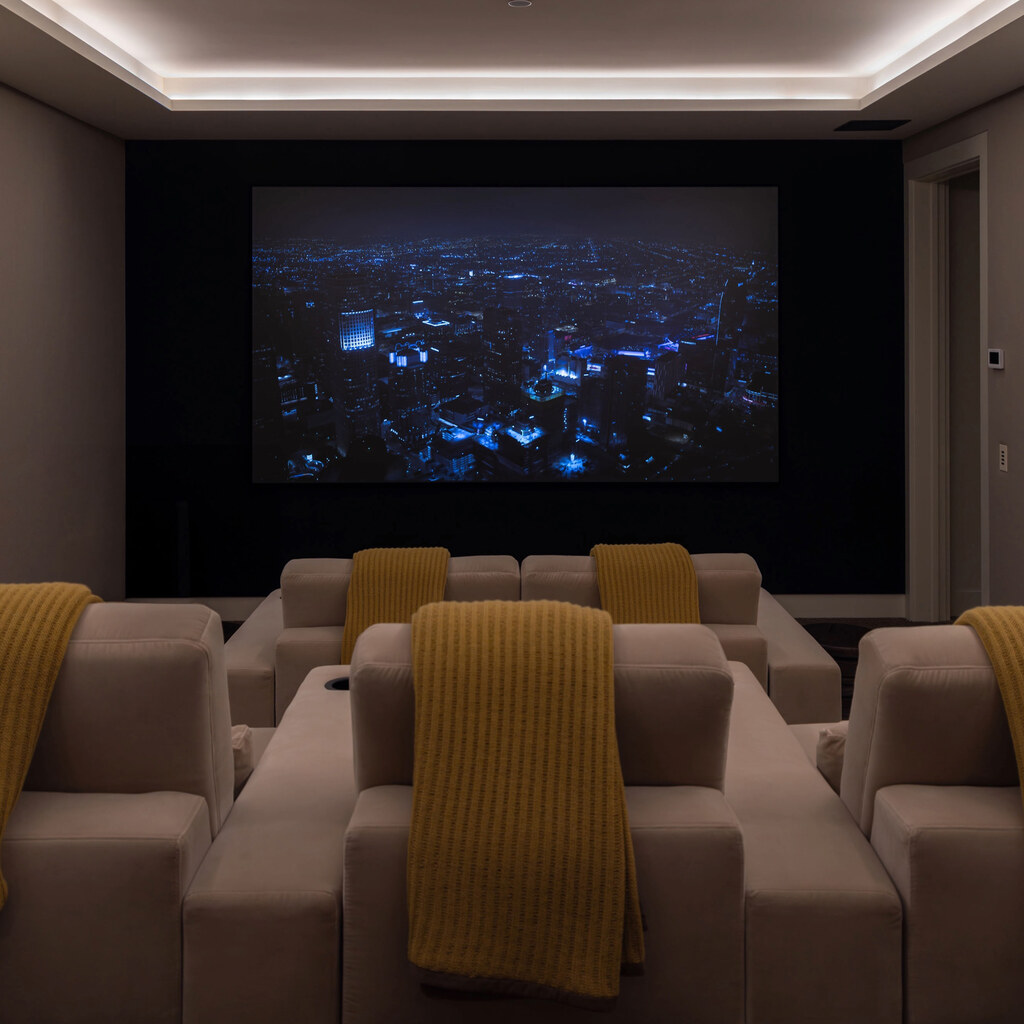
A dedicated theater gives us the chance to control nearly every part of the experience, and that’s much more than choosing a large screen and adding surround sound. Room dimensions, seating positions, speaker placement, acoustics, projector and screen selection, lighting, shading, ventilation, equipment location, and control all shape the finished result.
Done correctly, none of those individual pieces is what you notice. You notice the movie. A single command can prepare the entire room: lighting changes, the system turns on, the correct source is selected, and everything is ready. The complicated work happens during design and installation, so using it is the easy part.
When the Display Becomes Part of the Architecture
Not every project calls for a conventional television. Video walls, large-format displays, projection systems, motorized displays, and other custom solutions give us options for spaces where the experience or architecture calls for something different. But bigger isn’t automatically better.
Viewing distance, room size, ambient light, seating location, sight lines, and how the display looks when it isn’t in use all matter. In some rooms, the display should be a focal point. In others, it should practically disappear. The right answer depends on the room and what the client wants from it.
Where Does All the Equipment Go?
Ideally, most of the equipment required to make the system work isn’t something the homeowner needs to see, and that requires planning. Wiring needs to be designed before walls are closed. Equipment locations need adequate space, power, ventilation, and network connectivity. Speakers need to be coordinated with lighting, HVAC, structural elements, and architectural details.
On larger projects, much of the electronics can be located in centralized equipment racks away from the living spaces. The homeowner sees a clean television installation, a discreet speaker, or perhaps no visible speaker at all. Behind the scenes, everything is organized, serviceable, documented, and designed to work together.
That distinction matters. Hiding equipment is easy. Designing it so it can also be maintained and supported for years is far more important.
Simple Control Is the Result of Good Design
A sophisticated system should not require a sophisticated user. One of the most important parts of system design is deciding how the homeowner will interact with it. Turning on the television shouldn’t require three remotes. Listening to music shouldn’t require opening several apps. Starting a movie shouldn’t require remembering which input everything uses.
The interface should make sense, whether that’s a handheld remote, a wall-mounted touchscreen, a phone or tablet, a keypad, or a combination depending on the space. The homeowner doesn’t need to understand everything happening behind the scenes. They just need the system to respond the way they expect it to.
Technology Designed Around the Home
Every home is different, and so is every client. That’s why we don’t design systems around a predetermined package of equipment. We design around the architecture, the client’s priorities, and the experience they want to create.
Sometimes that means a dedicated theater with high-performance audio and video. Sometimes it means invisible speakers and a television that disappears when it isn’t in use. Sometimes it simply means making the systems already in the home easier and more reliable. The right technology is whatever technology provides meaningful value to the client.
Smart Home Systems has been designing and integrating audio, video, and home technology for homeowners in Bozeman and throughout Southwest Montana since 2000. We understand the technology. More importantly, we understand that our clients shouldn’t have to.
When the system is designed correctly, you don’t think about what’s happening behind the scenes. You just enjoy it.